In a small room above the gift shop at Portland Head Light, Esme Carriere unpacks a wooden crate from Birmingham, England, containing fourteen replacement prismatic elements.
The prisms are for the second-order Fresnel lens at Portland Head, in service since 1885, and they are not the original glass. The originals, where they remain intact, are still in place. The fourteen pieces in the crate are precise replacements for elements lost over the lens's 141-year working life.
Carriere is forty-one. She trained as a glass conservator at the West Dean College of Arts and Conservation in West Sussex, England, and worked for eleven years at the Corning Museum of Glass in upstate New York before moving to Maine in 2022.
She is one of perhaps thirty people in the world qualified to undertake conservation work on a Fresnel lens of this size. She is one of perhaps four currently working in North America.
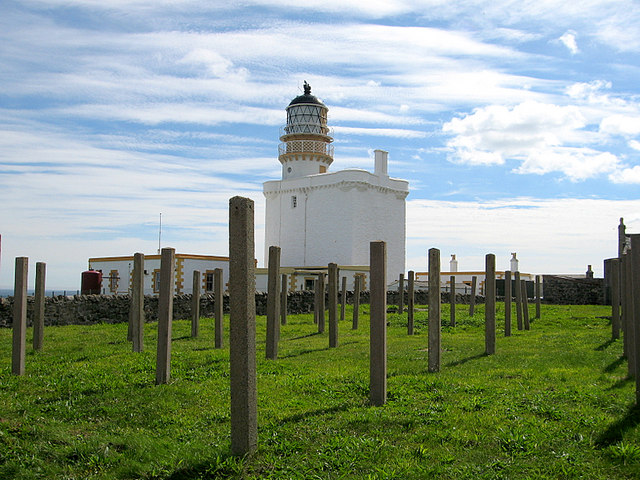
Portland Head Light stands at the entrance to Portland Harbor on the south shore of Cape Elizabeth. The tower, eighty feet of rubble stone construction, was completed in 1791 under a commission signed by President George Washington. It is one of the oldest continuously operating lighthouses in the United States.
The original light was a fixed white from an Argand lamp burning whale oil. The current second-order Fresnel was installed in 1885 to replace a smaller second-order lens that had been in service since 1855.
The 1885 lens has 656 prismatic elements arranged in a bell-shaped optical assembly twelve feet tall. It rotates on a mercury bath, driven now by an electric motor; the original Chance Brothers clockwork was retired in 1989 and remains in place in the cabinet beneath the lens but does not operate.
The lens is owned by the U.S. Coast Guard. Conservation work on it is contracted through the Cape Elizabeth Town Council, which holds a heritage lease.
Carriere's current contract, signed in February 2026, is for the replacement of twelve missing prisms in the upper bull's-eye assembly and two cracked elements in the lower catadioptric ring. The replacement glass was manufactured by a small specialist firm in Birmingham that has supplied Fresnel components since 1934.
Each replacement prism cost the Coast Guard, this magazine was told, just under nine thousand U.S. dollars. The total contract value is approximately one hundred and forty thousand.
The work room above the gift shop is not the work site. The actual installation happens in the lens room at the top of the tower, accessed by a spiral stair of seventy-six iron steps. The work room is for unpacking, cleaning, inspecting, and pre-fitting.
On the morning of the magazine's visit, May 17, 2026, Carriere had been at work in the room since 06:30. She had unpacked the crate, lifted each prism individually onto a felt-lined inspection table, and was now examining them under a 3x loupe lamp.
She works in cotton gloves. The skin oils from bare fingers, she said, can leave residues that are difficult to remove from a polished Fresnel surface, particularly along the joints between the optical element and its brass frame.
Each prism is held in a custom-cast brass frame. The frames for the replacement glass were cast in 2025 by a small foundry in Bath, England, working from drawings prepared at the National Lighthouse Museum in Liverpool.
The drawings, in turn, were prepared from measurements taken at Portland Head in October 2024. Carriere herself took most of the measurements. The brass frames fit the existing lens to a tolerance of two-tenths of a millimetre.
After the inspection, she fitted each prism into its frame in the work room, set it on the table, and checked the seating with a thin steel feeler gauge.
Twelve of the fourteen seated without adjustment. Two required minor work on the brass: one needed a thin paper shim along its lower edge; one needed a brass-wire brush applied to a small burr on the inner face of the frame.
The two adjusted prisms were set aside for re-checking on the following morning. The twelve that seated cleanly were repacked into a felt-lined transport tray for the climb up the tower the next week.
Installation, when it happens, is a slow process. Each prism is hoisted up the central well of the tower in a padded cradle on a manually operated block and tackle. Carriere positions each one by hand, on a small wheeled platform she rolls around the lens.
She estimates the full installation will take eleven working days. The lens will be out of service for the duration. During that period, a temporary LED marker is mounted on the tower's outer gallery to maintain the light's status as an active aid.
The work is funded partly by the Coast Guard and partly by a heritage grant from the Maine Lighthouse Trust. The trust raised the heritage portion, about forty thousand dollars, through a small auction at the Portland Yacht Club in September 2025.
Carriere expects to finish the prism installation by mid-June. After that, she will travel to Pemaquid Point to begin a smaller project: the cleaning and inspection of the fourth-order lens there, which has not had a full conservation survey since 2011.
She told the magazine that she does not anticipate finding much that is urgent at Pemaquid. The lens is small, the keeper's house caretakers have been attentive, and the salt air has, for now, been kind.