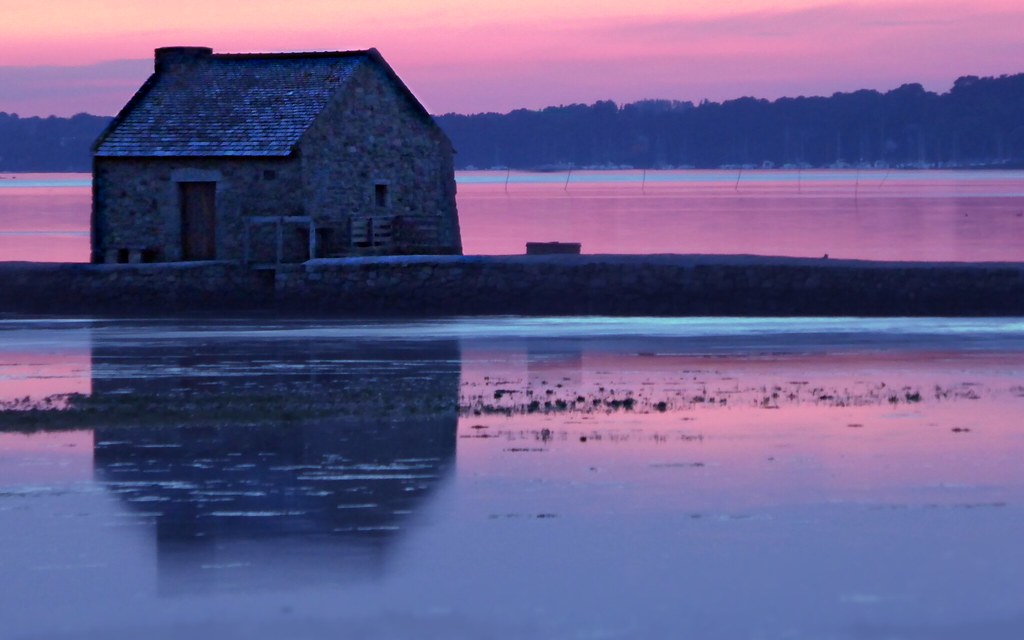
At 6:17 a.m. on 8 May 2026, the tide at the Ship Harbor Nature Trail, on the south shore of Mount Desert Island, was at its low. The air was nine degrees Celsius. The granite was wet and slick, and the rockweed lay flat against the stone in dark mats.
There was no one on the trail. The summer crowds at Acadia National Park do not arrive in volume until late June. In May, the visitor logs at the park's Hulls Cove headquarters show roughly an eighth of the foot traffic of August.
The pools, however, are at their best in the shoulder season. The water is colder, which keeps the algae in check. The pools are clearer. The animals are easier to see.
Mira Iyer, who edits Sea Marker's Lighthouses section from Cochin, has been visiting Acadia for two weeks every May since 2019. The visit was originally meant as a trip to Bass Harbor Head Light. The tide pools were a discovery.
"You can stand on a rock the size of a kitchen table," she said, "and find six species in a pool the size of a soup bowl. You just have to wait until your eyes adjust."
The pools at Ship Harbor are mid-intertidal. The high pools, above the mean high water line, hold mostly periwinkles and barnacles. The low pools, exposed only at the bottom of a spring tide, hold sea stars and sometimes a small fish or two.
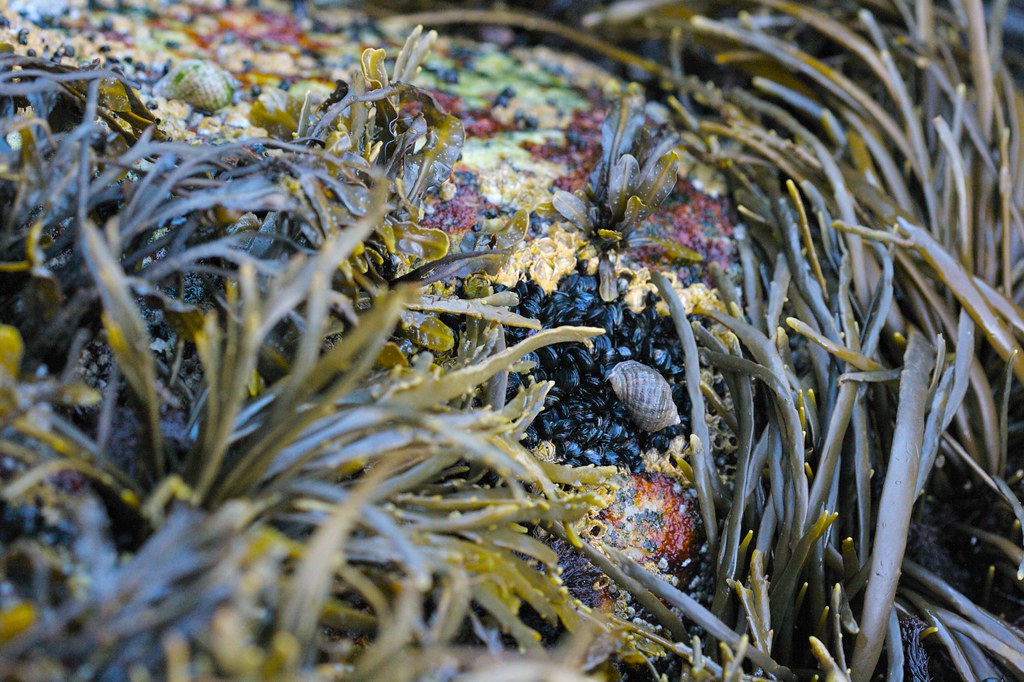
On 8 May the visible animals included, in order of appearance: common periwinkles, dog whelks, blue mussels, acorn barnacles, a single hermit crab in a borrowed periwinkle shell, a green crab the size of a coin, three asterias forbesi sea stars, and one northern rock barnacle the size of a thimble.
The hermit crab spent twenty minutes considering whether to leave its pool for an adjacent one. It did not leave.
The intertidal zone at Ship Harbor is granite, fractured along ancient joints into rectangular blocks that the surf has rounded only slightly. The pools form in the joints. Some are no deeper than a coffee cup. Others are knee-deep and run for several metres along a single crack.
The mid-intertidal community on this coast is dominated, ecologically, by three species: Mytilus edulis, the blue mussel; Semibalanus balanoides, the acorn barnacle; and Fucus vesiculosus, the bladderwrack. They sit in horizontal bands, each band the result of a small daily contest with desiccation, predation, and competition for space.
The bands are visible from a distance, if you know to look for them. Up close they resolve into individual animals and individual plants, each holding a square millimetre of rock against the next claimant.
The intertidal is one of the most heavily studied ecosystems in the world. Robert Paine's 1966 experimental removals of the sea star Pisaster on the Washington coast produced the original keystone species concept. Acadia's eastern equivalent of that work, mostly less famous, has been ongoing at the College of the Atlantic since the 1970s.
The local sea star, Asterias forbesi, has been hit hard in recent decades by sea star wasting syndrome, the same condition that devastated Pisaster populations on the Pacific coast in 2013 and after. Counts at Schoodic Point, on the mainland side of the park, were down by about 70 percent between 2014 and 2019, and have only partially recovered.
On 8 May at Ship Harbor, the three sea stars in the lowest pool were small, between four and seven centimetres across. Three is not a recovery. It is a sign of life.
The shoulder season has practical advantages. Parking is unrestricted. The composting toilets at the trailhead are open and clean. The Park Loop Road is open as of mid-April and quiet through May.
It also has a cost. The water is cold enough that an unintended dip is a serious matter. The granite is slick enough that the National Park Service advises wool socks over boots for the descent to the pools, a piece of advice that sounds odd until it has been tried.
The mid-day high tide on 8 May arrived at 12:34 p.m. By eleven, the lowest pools were already filling. The sea stars had retreated into the rockweed. The periwinkles, which are mobile but slow, had not bothered to move.
By twelve-thirty the rocks where Mira had been standing at dawn were under a metre of clear cold water. By one, the trail was empty again. A single park volunteer in a green hat passed on his way to check the next bay over.
He did not stop. He had a tide chart in his pocket and a thermos in his hand. He nodded once and kept going.