The kettle in Margery Tilley's kitchen, in Port Rexton, Newfoundland, sits on a propane two-burner that was installed in 1972. Above the burner, on a nail driven into a strip of pine, hangs the current year's tide booklet from the Canadian Hydrographic Service.
The booklet is replaced once a year, in January, when the new edition arrives by mail from St. John's. The nail has been in the wall since 1985. Margery Tilley is 73.
The booklet is forty-eight pages. It is bound in pale blue card stock. The cover bears the federal coat of arms and the words Canadian Tide and Current Tables 2026, Volume 1: Atlantic Coast and Bay of Fundy. The print run is small. The booklets are sold for $14 by chandleries up and down the Atlantic provinces.
Margery's husband, Cyril Tilley, fished cod and capelin from Trinity Bay for forty-one years until the federal moratorium of 1992 ended his career. After 1992 he ran a small water taxi for tourists out of Trinity and Port Rexton until 2014. He died in 2019.
The tide booklet was his. Margery has continued the subscription.
"I am not on the water," she said in March. "I have not been on the water for twenty years. But the book stays on the nail. I look at it most mornings."
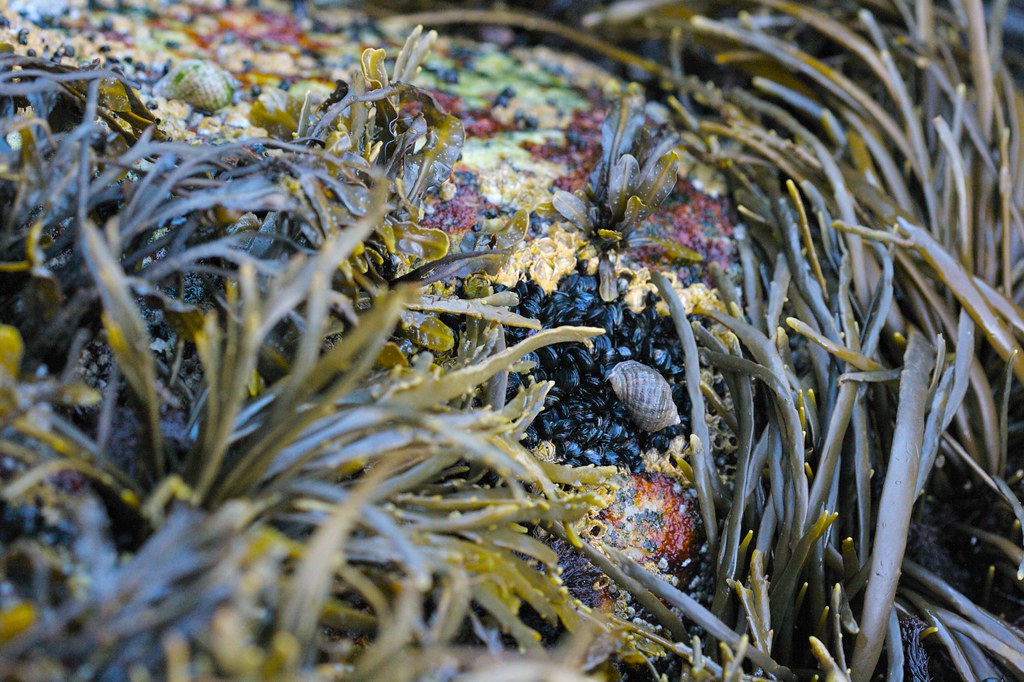
What she looks at, mostly, is the time of the next low water. The clams at Lockston Path Provincial Park, a fifteen-minute drive from her kitchen, are accessible only at low tide. Margery digs clams. She has dug clams since she was eight years old.
At spring tides, the flat at Lockston exposes for about an hour and a half on either side of low water. At neap tides, the window shrinks to forty-five minutes. The clam licences issued by the Newfoundland Department of Fisheries permit a daily harvest of 200 soft-shell clams per household. Margery takes about sixty.
She freezes most. She eats the rest with butter and parsley.
The tide booklet's predictions for Port Rexton are extrapolated from the reference station at Argentia, which has a tide gauge maintained by the Marine Environmental Data Section in Ottawa. The corrections for Port Rexton, printed in the back of the booklet, are a time offset of plus 47 minutes and a height factor of 0.84.
Margery does not do the arithmetic. She has memorised it.
Beside the booklet, on the same pine strip, hangs a wooden ruler with the years 1985 through 2026 burned into it in a column down one side. Beside each year, in pencil, is a single number. The numbers are in metres.
The number is the highest tide of the year at Lockston Path, as observed by Margery on a granite boulder at the edge of the flat. She marks the boulder with a chalk line at the wet edge and reads the height from a string she carries in her coat pocket.
The string has small knots tied at ten-centimetre intervals from a fixed point at the base of the boulder. The fixed point is the spot, scratched into the granite with a nail, where Cyril marked his own observation in 1985. He marked it because the tide that year was the highest he could remember. The number on the ruler beside 1985 is 1.94.
The numbers between 1985 and 2026 trend upward. The trend is small. It is also, Margery insists, real.
"You ask any old man in Trinity Bay," she said. "They will tell you the tide is bigger. The book does not say that. The book says the same thing it said forty years ago, give or take. The shore says different."
The shore is, in fact, saying different things. The tide gauge at Argentia shows a mean sea level rise of roughly 2.1 millimetres per year since 1985, or about 8.5 centimetres over Margery's observation period. Her boulder records have shown an upward drift of around 11 centimetres over the same span, slightly larger.
The extra three centimetres are within the uncertainty of a hand-tied string read from a chalk line on wet granite by a 73-year-old woman in a southwest wind. They are also, possibly, real, and reflect local subsidence, sediment loss at the flat's edge, or a slow shift in the storm climatology of Trinity Bay.
She does not care which. She cares that the number on the ruler beside 2025 is 2.07. She suspects 2026 will be 2.09.
The booklet on the nail will tell her, in late May, when to go look. The boulder at Lockston will tell her the answer. The pine strip on the wall above the kettle will keep the record, in pencil, for whoever takes the kitchen after her.