The Northern Lighthouse Board's decommissioning crew arrived at the small light at Eilean Glas on a Tuesday morning in late April, on the 09:40 ferry from Tarbert.
There were four of them: Ranald Cameron, the senior engineer; Ishbel Mackay, the heritage liaison; an electrician named Calum; and a younger surveyor whose name the magazine recorded as Iona Buchan.
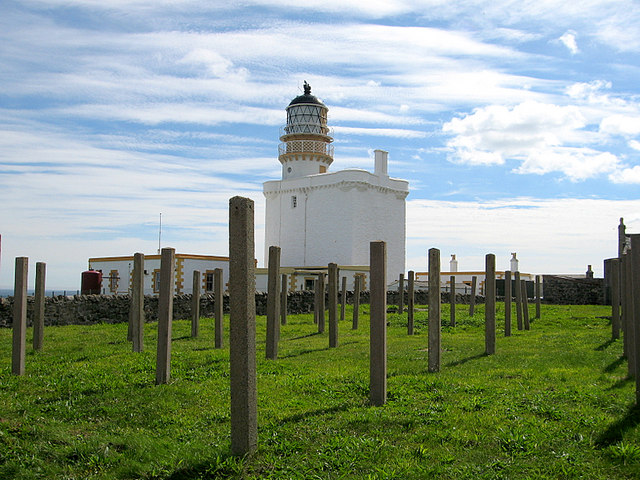
Eilean Glas is on the eastern shore of Scalpay in the Outer Hebrides. Its tower, eighty feet of granite-block construction, is one of the older lights in Scottish waters. The original was built by Thomas Smith in 1789. The current tower, the third on the site, dates from 1907.
The light has been automated since 1978. The keepers' cottages, three small dwellings clustered at the base of the tower, were sold off in the 1980s and are now privately owned. The tower itself remained NLB property.
The board's decision, announced in November 2025, was not to demolish but to decommission: to remove the active light and replace it with a smaller, mast-mounted LED beacon a hundred metres west of the tower.
The tower will remain. It is a Category A listed building, the highest grade of statutory protection in Scotland.
The crew's job, on this Tuesday and through the following three weeks, was to remove the existing third-order Fresnel lens, the rotation drive, the lamp assembly, and the duty cabinet. The granite tower would be left dark and weather-sealed.
Cameron is fifty-four. He has worked for the NLB for twenty-nine years and has overseen, by his count, eleven decommissioning operations on Scottish lights.
He has not enjoyed any of them. He told the magazine, over a thermos of tea in the lower gallery of the tower on the second morning, that there is a particular kind of quiet that takes hold in a lighthouse the day after its lens is removed, and that he has never made his peace with it.
Mackay, the heritage liaison, has been with the board for nine years. Her role on a decommissioning is to document each removed component, identify any items of heritage value, and arrange for their conservation or transfer to a museum collection.
The Fresnel at Eilean Glas was manufactured by Chance Brothers of Birmingham in 1906. It is a third-order lens, six feet tall, with a focal length of 500 mm. It has been continuously rotating since it was installed in February 1907.
The lens will go to the Museum of Scottish Lighthouses at Fraserburgh, where a small wing has been prepared for it.
Removal of a Fresnel of this size is not casual work. Each of the 196 prismatic elements is held in a brass frame, and the entire optical apparatus sits on a turntable that itself sits in a bath of mercury.
The mercury was drained on the second morning, into stainless-steel containers sealed for transport. Roughly 130 kilograms of mercury were recovered. It will be reused in the maintenance of other heritage lenses still in service.
On the third morning, Calum and Iona began the disassembly of the prismatic elements. They worked from the top down, photographing each prism in place before removing it, numbering it, and packing it into a wooden crate lined with foam.
The work proceeded at a pace of roughly twenty prisms per day. The full lens disassembly took ten working days.
Cameron, during these days, worked in the lower gallery on the lamp assembly and the duty cabinet. The lamp itself, a 1,000-watt tungsten-halogen of a type the board has used since the late 1990s, was removed and stored for re-use.
The duty cabinet, the control hub for the rotation, the lamp changer, and the photocell switching, was removed intact and shipped back to the NLB's depot at Oban.
On the morning of May 18, the last prism came out of the frame. Mackay, who had been keeping a written log of every component, closed the notebook and put it in her bag.
The four of them stood for a few minutes in the empty lens room. The room is octagonal, glazed on seven of its eight sides, with a copper ventilator dome above. Without the lens, it felt larger than it had on the first day.
Iona, the youngest, said it looked like a church with the altar gone. Cameron did not reply.
On May 21, a contractor's crew arrived to commission the LED beacon on its mast. The mast is twelve metres tall, painted galvanized grey, with a synchronized LED head that flashes white every twenty seconds, the same character as the old light.
The new beacon went into service at 20:14 on May 21. The old tower was sealed at the gallery door and the storm shutter on the lens-room windows was lowered for the last time. The keys were turned over to the local Eilean Glas Trust, who plan to open the tower for guided visits on Saturdays through the summer.
Cameron caught the 17:25 ferry back to Tarbert. He did not look back at the tower from the deck. He told the magazine afterward that he had learned, eleven decommissionings in, that this small refusal was the only kindness he could still offer.