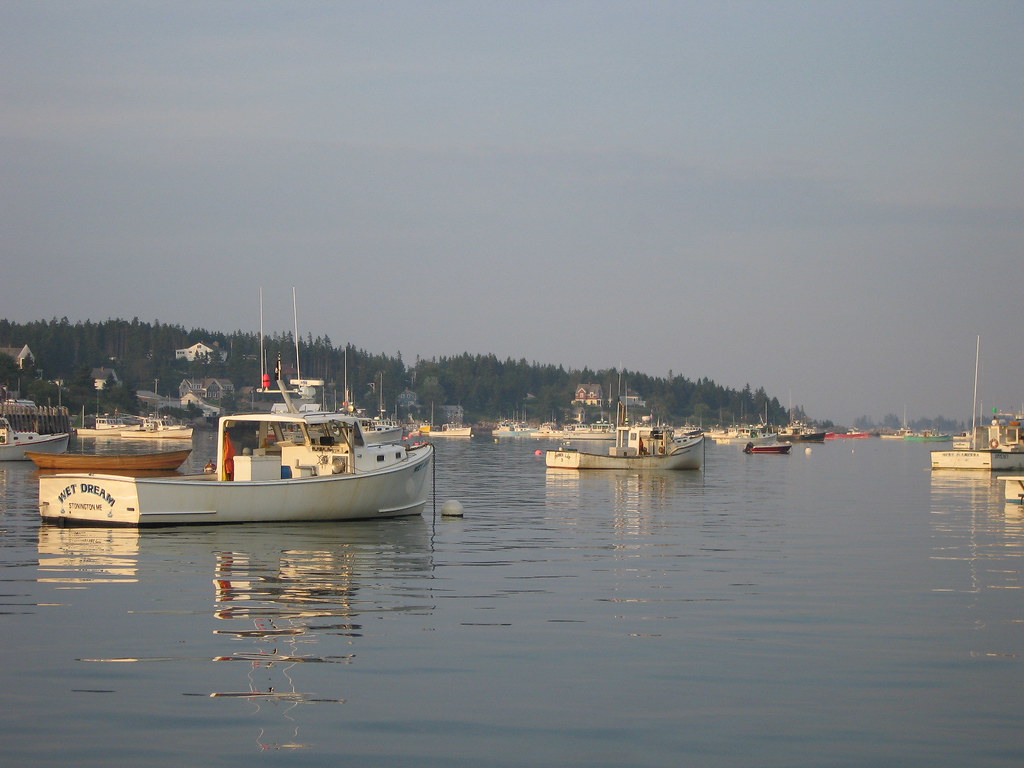
At 4:42 a.m. on a Tuesday in November, Caleb Eaton steps onto the float at the Stonington town pier in rubber boots and a wool watch cap, and the boards take his weight without complaint. The harbour is quieter than it will be in any other month of the year. Three boats have already left. Six more are warming up.
Eaton is thirty-eight and has been lobstering out of Stonington since he was twelve, when his father let him haul his first trap from a skiff off Crotch Island. The boat he runs now is the Mary Iris, a 42-foot Wayne Beal hull built in Jonesport in 2014, repowered last winter with a 600-horsepower Cummins.
Stonington has been the largest lobster port in Maine by landings for most of the past two decades. In 2025 the town's boats brought in just over 13.4 million pounds, worth somewhere near $58 million at the dock, depending on which co-op you ask and which month. November is not a big month.
The water temperature on the chart this morning reads 44 degrees Fahrenheit at the surface and probably four colder on the bottom. Lobsters have started their slow walk into deeper water. The traps Eaton hauls today sit between 110 and 180 feet, on a ledge southeast of Isle au Haut.
He pulls the first string at 6:15, by which time the sky has gone the colour of wet slate. The first three traps come up with one keeper between them. The fourth holds two shorts and a sculpin. Eaton measures the shorts with a brass gauge older than he is, drops them back, and rebaits with redfish racks from a five-gallon pail.
The work is the same as it has been for a century, except in the ways it isn't. The Sterling hauler is hydraulic. The plotter shows every trap as a yellow dot on a coloured chart. The VHF is set to channel 6, where the Deer Isle boats talk, and to 16 for the Coast Guard.
By 9:30 the wind is up from the northwest at eighteen knots and the chop is starting to slap the transom. Eaton is wearing oilskins over insulated bibs and has not yet taken off his gloves. He has hauled 240 traps. He has 180 to go.
The lobster he saves go into a saltwater tank at the stern, separated by size and banded at the claws with rubber bands the colour of traffic cones. He has 86 pounds aboard at noon. The price at the co-op this week is $5.40 a pound for selects. It was $7.85 in July.
The Stonington Lobster Co-op was founded in 1948 and has 78 members in 2026. It runs a fuel dock, a bait freezer, and a buying station at the head of the pier. The co-op's manager, Sarah Billings, has been in the office since 5:30. She knows what every boat in the harbour caught yesterday and what it is likely to catch today.
Billings says the November numbers are running about twelve per cent below the five-year average. She does not say this with alarm. The five-year average includes 2022, which was the second-best year on record. The boats here have learned to be careful about which baseline they use.
Out on the water, Eaton hauls a trap with a single large female in it, eggs visible on the underside of the tail. He notches a small triangular cut in the right flipper of the tail with a knife kept sharp for the purpose and lowers her back into the sea. A v-notched female is protected for the rest of her life. The notch grows out slowly. The lobster might live another forty years.
Maine's lobster fishery has practised v-notching since the late nineteenth century. It is one of the reasons the stock has lasted. The other reasons are minimum and maximum size limits, trap caps, and a licensing system that has not admitted new entrants in most zones for more than two decades.
Zone C, which includes Stonington, has had a waiting list since 1999. A young person who wants to fish here typically buys a licence from a retiring sternman or inherits one. Eaton's son, who is eleven, is on the apprentice list, which means that for two hundred days over the next two years he will fish as a student aboard a licensed boat.
By 2:00 p.m. the Mary Iris is back at the float. Eaton has hauled 420 traps and kept 138 pounds of lobster. He pays his sternman, a 23-year-old named Cooper Greenlaw, two hundred and forty dollars and a six-pack of bait herring. He fuels the boat, washes the deck, and walks to the co-op to weigh out.
The walk takes seven minutes. Stonington in November has thirty-four restaurants closed for the season and four open. The Harbor Cafe is one of the four. Eaton stops there for chowder and is back at the pier by 3:45.
He will be on the water again tomorrow if the wind is under twenty-five knots and the seas are under five feet. The forecast for Wednesday is northwest twenty gusting thirty. He will probably stay in and work on traps.
There are 280 traps stacked in his yard at home. Sixteen need new bricks. Forty need new hog rings. Six need new bottoms. The work takes longer in cold weather because the rope is stiff and the gloves are necessary.
Eaton's grandfather fished from a sailing peapod in the 1930s and made, in a good year, about half what Eaton makes in a bad month. The comparison is not as cheerful as it sounds. The grandfather owned his boat outright. The grandfather did not have a $190,000 diesel engine to amortise.
What Stonington has, that other fisheries on the New England coast have largely lost, is continuity. The boats are owned by the people who run them. The licences are inherited. The co-op is owned by the fishermen who sell to it. The town meeting is attended.
It is a thin kind of continuity, held in place by rules that the fishermen helped write and by a stock that has been managed, by most accounts, well. Whether it holds for another twenty years depends on water temperature, on right whale regulations being argued in federal court, and on whether the eleven-year-old on the apprentice list still wants to do this when he is twenty.
Eaton drives home at quarter past four, in the dark. The kitchen light is on. His wife teaches at the Deer Isle-Stonington Elementary School. Dinner is haddock chowder, again. The forecast has not improved.