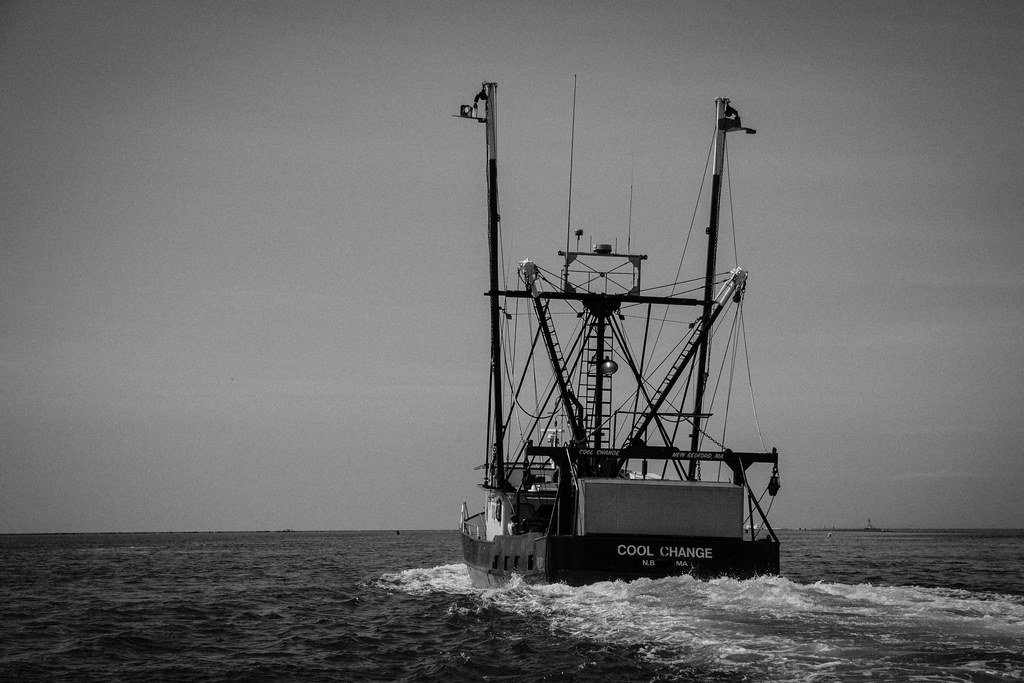
The Sea Hawk II ties up at Pier 3 in New Bedford on a Sunday morning in April with 17,800 pounds of shucked scallop meat in 40-pound bags, frozen in seawater brine and packed into the boat's refrigerated hold. The trip has lasted eleven days. The boat is 87 feet long. The crew is seven, including the captain.
The captain is Joao Tavares, who is forty-six and has been running scallop boats out of New Bedford since 2008. He came to the fishery as a teenager from São Miguel in the Azores, the way a substantial fraction of the New Bedford scallop fleet did. The boat is owned by a family corporation that owns four other vessels and a shoreside packing plant.
New Bedford has held the title of highest-value fishing port in the United States every year from 2002 through 2025. The port's landings value in 2025 was $471 million. Sea scallops, Placopecten magellanicus, accounted for about 78 per cent of that. The rest was groundfish, monkfish, squid, and a small mixed-species inshore catch.
The scallop fleet that lands at New Bedford is somewhere between 280 and 320 vessels, depending on how you count limited-access general-category permits. The fleet is concentrated. The top fifty boats land roughly 60 per cent of the catch.
The fishery has been on a rotational area management plan since 2004. Specific areas of Georges Bank and the Mid-Atlantic are closed for two to four years at a time and reopened when surveys show large recruitment. Boats receive trip allocations measured in days-at-sea for open areas and in pounds for access areas.
The system has worked, on most measures, better than almost any other federal fishery management plan. The biomass has been rebuilt. The price has held. The boats have remained American-owned and largely family-owned. The crews are paid on a share system that, in good years, can pay a deckhand $180,000.
The quiet crisis of 2026 is that the recent surveys have been bad. The 2024 dredge survey, conducted by the Northeast Fisheries Science Center and the SMAST scallop survey out of UMass Dartmouth, showed substantially reduced biomass in the major access areas of Georges Bank and a poor recruitment signal across most of the Mid-Atlantic.
The 2026 fishing year, which began on April 1, has a total allowable catch about 28 per cent below the 2024 season and 41 per cent below the 2020 season. The trip allocation for a full-time limited-access boat fell from 24,000 pounds per access trip to 17,000.
Tavares makes the math work because the price at the dock has risen. The April 2026 average for U10 scallops — the largest size class, packed at ten or fewer per pound — was $18.40 a pound. The U12 grade was $15.90. The boat's trip grossed about $312,000.
After fuel, ice, bait, food, and the owner's share, the crew's share for the eleven-day trip works out to roughly $26,000 per deckhand. The mate's share is larger. The captain's share is larger still. The owner takes about 38 per cent of the boat share.
Tavares does not own the boat. He owns a smaller boat, a 56-foot inshore dragger that his brother runs out of Provincetown for groundfish, and he holds a small piece of equity in a shoreside processing operation in Fairhaven. The economics of vessel ownership at the scale of the Sea Hawk II have largely passed individual captains by.
The shoreside infrastructure at New Bedford is one of the reasons the fleet remains profitable. Six major processors operate within walking distance of the city's working waterfront. The unloading crews, mostly Cape Verdean and Mayan, are organised by a local of the United Food and Commercial Workers and earn between $28 and $36 an hour.
The processors ship to a domestic market that has, in the past decade, expanded substantially. The retail price of fresh sea scallops in a Boston-area supermarket in April 2026 was $32.99 a pound. The same scallops cost $19.99 in 2018. The increase has not depressed demand.
What concerns the New Bedford operators in 2026 is not the price but the biomass. The 2025 year class, according to the most recent SMAST survey released in March, looks weaker than the 2023 class, which was already among the weakest in fifteen years.
The rotational management system assumes that closures produce recruitment. If recruitment is not producing, the system has a thinner margin. The New England Fishery Management Council's scallop committee has scheduled additional surveys for late 2026 and is considering further closures, additional gear restrictions, and a reduction in the general-category allocation.
Tavares's view, expressed at the kitchen table of a Portuguese restaurant on Acushnet Avenue on the Monday after his trip, is that the fishery has been through bad cycles before and that the management system, while imperfect, has been better than what most of the country's other federal fisheries have done. He notes that he has been wrong before.
What is harder to evaluate is whether the cycle in front of the fleet now is a cycle, or a slower change driven by warming water and shifting currents in the Mid-Atlantic. The scallop is a temperate-water animal with a narrow tolerance for warm bottom water. The bottom-water temperatures on the Mid-Atlantic shelf have risen measurably in the past fifteen years.
The scallop processors and the boat owners and the shucking houses and the unloading crews and the ice dealers and the welders who fabricate the dredges all employ, between them, more than three thousand people in greater New Bedford. The city's median household income is well below the state median. The fishery is what holds the difference up.
Tavares will sail again on Friday, weather permitting. The next trip is into an open area off the southern flank of Georges Bank, where the August survey showed reasonable biomass and where the closer access areas have been picked over in recent months.
He will be home, if the weather cooperates, by the third of May. His daughter, who is fourteen, will have a softball game that Saturday. He has not missed one this season. He has missed a great many over the past twenty years.