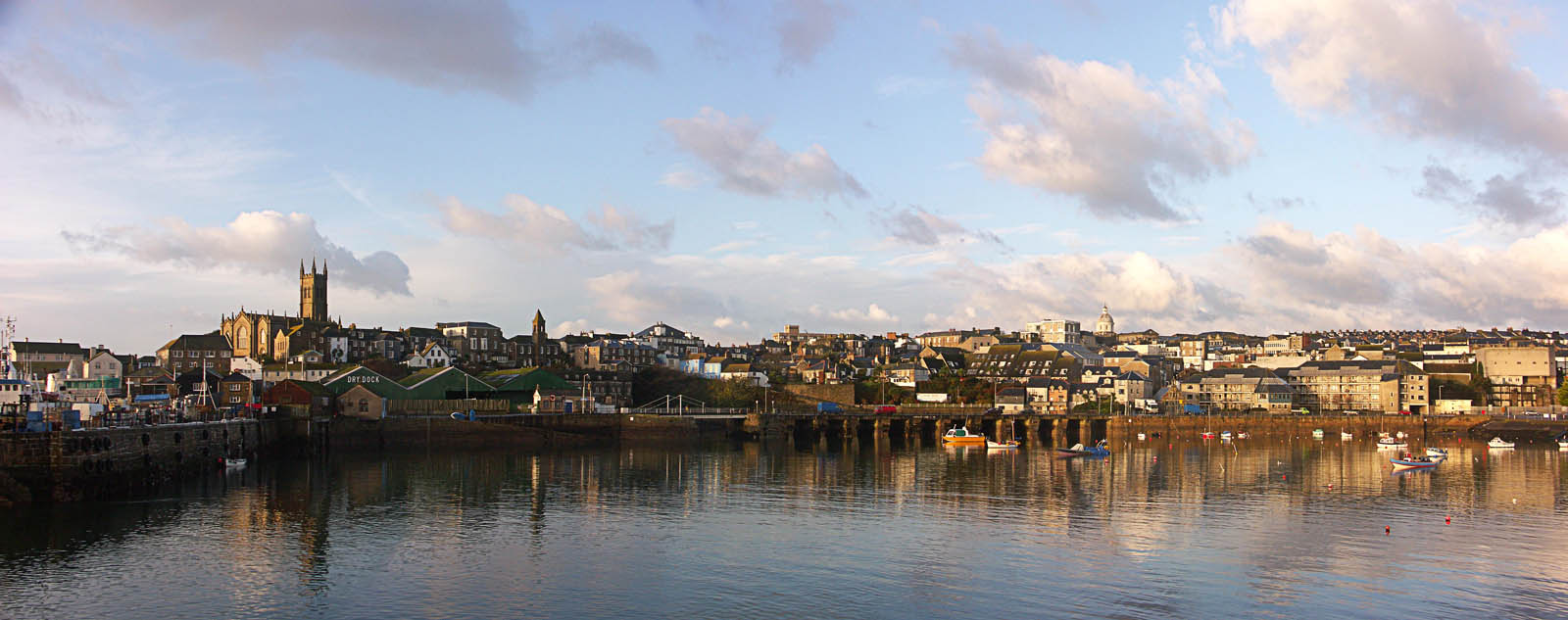
On the third of October the wind in Mounts Bay turned and stayed turned for nine days. The Scillonian III, the passenger ferry that links Penzance to St Mary's in the Isles of Scilly, cancelled three crossings out of four that week. By the eighth, the harbourmaster's noticeboard at the Wharf Road office read simply SAILING UNDER REVIEW, in white plastic letters the wind kept rearranging.
Penzance in October is a town between two seasons. The visitor centre on Market Jew Street closes at four instead of six. The Jubilee Pool, the great seawater lido at the eastern end of the promenade, has shut for its winter works and the geothermal pool at its centre is steaming gently behind hoardings.
The town's population, around 21,200 in the 2021 census, falls noticeably in October. The seasonal workers in the hospitality trade go back to Plymouth or to Romania or to wherever they came from. The Cornish themselves stay, of course, but they stay indoors more.
At the Honey Pot on Parade Street, Geraldine Trembath has been making the same vegetable soup for eleven years and serving it with a slice of saffron bread. In October the soup goes up by fifty pence and the slice of bread becomes two slices. "It's the cold," she said, when asked about the change. "People need more in October. They don't know it yet, but they do."
Trembath is sixty-three. She came back to Penzance in 1989 after sixteen years in Bristol. Her father had been a fisherman out of Newlyn, the working harbour just west of Penzance, and her grandfather a tin miner at Geevor. She runs the cafe alone in winter and with one part-time helper from May to September.
Newlyn, fifteen minutes' walk along the promenade, is where Penzance's fish actually comes in. The Newlyn fish market handles roughly twelve thousand tonnes a year, much of it sold within hours into the European supply chain via the truck park on the harbour. In October the catch is heavy on hake, monkfish, and the last of the summer mackerel.
At dawn on the fifth of October, the auction floor at Newlyn was nearly full. Buyers from three London merchants and one from Madrid were working the bins. The auctioneer, a man named Trevor Care who has been on the floor since 1998, was moving at a pace that the visitor could not follow.
"You learn it," he said afterwards, over a tea in the canteen above the floor. "It's like a foreign language. After a few years you don't hear the speed any more."
The Penzance-to-Scilly route has been operating in one form or another since the 1820s. The current vessel, the Scillonian III, was launched in 1977 and is one of the last all-British-built passenger ferries still in regular service from a British port. Its replacement, a vessel to be named the Scillonian IV, has been in commission discussions since 2019.
In the meantime the III runs from Easter to early November and the freight ship Gry Maritha picks up the year-round duty for the islands. The III's master, Captain Aled Pencreek, is in his nineteenth season. He says October is his favourite month at sea, when it cooperates.
"You get the light off the granite," Pencreek said, on the bridge between sailings. "In summer it's hazy. In October the air is clean and the Wolf Rock lighthouse stands out like a finger."
The Wolf Rock light, eight miles southwest of Land's End, was completed in 1869 and automated in 1988. It marks the western edge of the approach to Mounts Bay. From the deck of the Scillonian on a clear October afternoon, it is one of three lights visible at once, with the Longships off Land's End and the Bishop Rock at the western end of the Isles of Scilly.
On the western edge of Penzance, the village of Mousehole holds its own October rhythm. The Christmas lights, the famous Mousehole lights that draw fifteen thousand visitors over the holiday period, are tested in late October and rigged in November. The vicar at St Pol de Léon, Father Cadan Pengelly, runs a Sunday evening service through the autumn that fills the church on the longest nights.
Pengelly came to Mousehole in 2018 from a city parish in Plymouth. He says the October congregation tends to be a steady forty, with a handful of arrivals through November as the dark draws people in.
The October weather in Penzance averages 14 degrees Celsius by day and 9 by night. The town gets about 130 millimetres of rain in the month. The wind, when it sets in from the southwest, can run for a week. Geraldine Trembath calls these the cooped weeks. The Cornish word for them, she said, is kibbel, although she allowed she may have invented that.
By the second week of October the cruise traffic into Falmouth, an hour east, has dropped to two or three calls a week. The Penzance Heliport, which used to run a service to Scilly until 2012 and reopened in 2020, runs four return flights a day in October, weather permitting.
At the Morrab Library, a subscription library founded in 1818 and tucked into a small park off Morrab Road, the autumn schedule has begun. The library holds about 50,000 volumes and is one of the oldest independent subscription libraries in the country. Its head librarian, a quiet woman named Annis Tregenza, runs a Saturday-morning Cornish-language conversation group from October through March.
The group meets in the reading room above the gardens. On the fourth of October there were eight people present, including a retired GP from Helston and a young woman from London who had moved to Penzance for the cost of living. The lesson concerned the present continuous tense and the names of fish.
Outside, the rain had started again. The wind had come back around to the southwest. The Scillonian, which had been due to sail at 09:15, was still tied at the Lighthouse Pier with its lines doubled and the gangway taken up. The harbourmaster's noticeboard now read simply NO SAILING TODAY.
Trembath, closing the Honey Pot at four, said that was October. The town would do its work. The boats would sail when they could. The visitors would be back in April. The light off the granite would stay clean a little longer.