The schooner Bluenose II, in winter berth at the wharf in Lunenburg, Nova Scotia, is a working vessel that doubles as a provincial emblem. Her decks are scrubbed weekly through the off-season. Her standing rigging is inspected to a written schedule.
Lavinia Sinclair was given access to the boat on a Wednesday afternoon in April by Mate Calvin Tanner, who has worked on her crew since 2003. He showed her, in particular, a length of three-strand polyester used on the main throat halyard.
At the bitter end of the line is a whipping in waxed cotton twine, dark brown, two centimetres long, finished with a needle-buried tail and a smear of clear shellac. Tanner pointed at it. That whipping, he said, was put on by a rigger named Doug Bartlett in 1994.
The rope itself has been replaced twice since. The whipping was each time carefully cut from the old rope and re-installed on the new, by the same rigger, who is now in his late seventies and still occasionally consulted.
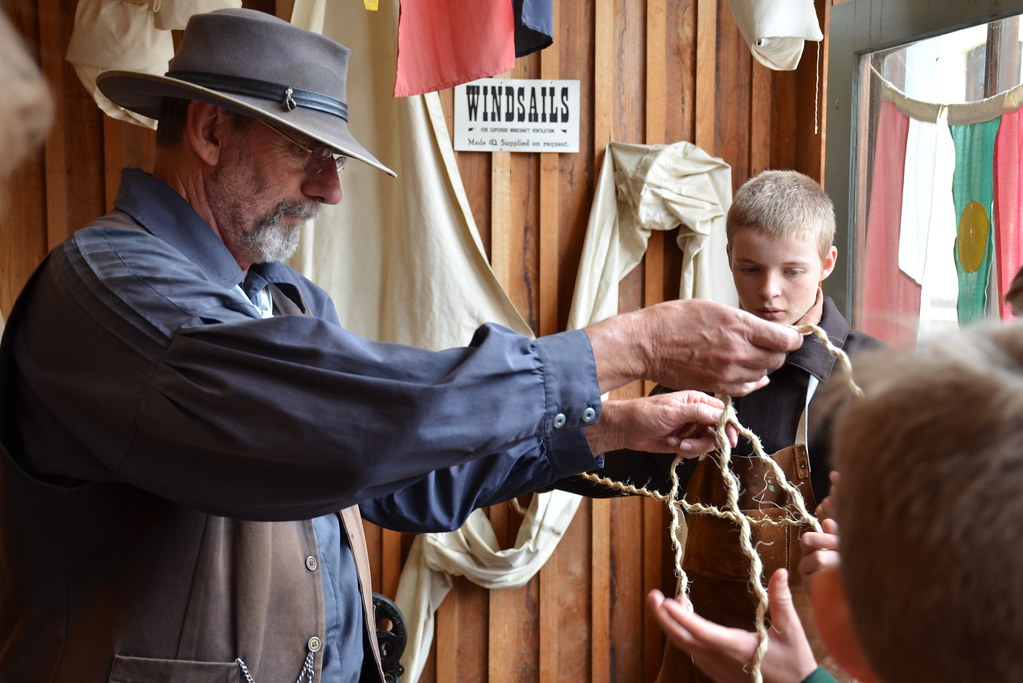
A whipping is a small binding of fine twine wrapped tightly around the end of a rope to prevent the strands from unlaying.
There are perhaps a dozen forms. The simplest, called the American or common whipping, is wrapped without any needlework and is finished by passing the end under the wraps with the help of a small loop.
The West Country whipping is wrapped with overhand knots on alternating sides of the rope and finished with a square knot. It is the easiest to put on without a needle and is widely taught to children at sailing schools.
The sailmaker's whipping is the form most often found on professional vessels. It uses a needle to pass the twine through the rope at intervals, locking the wraps in place and producing a whipping that will not unravel even if cut at one end.
Bartlett's whipping is a sailmaker's, with three pass-throughs in the conventional manner, then a refinement of his own. He buries the working end of the twine back through the centre of the wraps for a full centimetre before cutting it off flush.
This is not a standard finish. Most sailmaker's whippings end at the third pass-through. Bartlett's additional bury adds perhaps two minutes of work and, in Tanner's observation, doubles the working life.
The materials matter as much as the technique. Waxed cotton sailmaker's twine, in either three-cord or six-cord weight, is the traditional choice. It grips the rope and itself, holds a knot, and weathers slowly.
Synthetic substitutes are stronger but slipperier. Tanner has seen polyester whippings come loose in a season on a fast offshore yacht. The cotton equivalent, properly buried, lasts indefinitely.
Sinclair, who has been writing about North Atlantic fisheries since 2008, has interviewed perhaps two hundred working sailors over those years. She estimates that fewer than one in ten can put on a proper sailmaker's whipping.
Most modern boaters substitute heat-shrink tubing or a quick application of melted nylon to the rope's end. Both work in the short term. Neither lasts. The heat-shrink degrades in UV. The melted-nylon plug eventually cracks off, often catching a sheet at an inconvenient moment.
Bartlett, when Sinclair telephoned him at his home in Mahone Bay, said the trouble with most whippings is that the rigger hurries the start. The first three or four wraps, he said, must be perfectly tight and parallel. After that the whipping holds itself in line and the work proceeds easily.
He learned the technique from his father, who had been a sailmaker in Halifax until 1971. His father had learned from a Newfoundlander named Peter Ryan who had served on the dory schooners of the Grand Banks in the 1920s.
The lineage is conventional for the trade. Whippings of this quality are taught hand to hand, not from books.
Sinclair asked Tanner whether the Bluenose crew expected the original 1994 whipping to remain in service indefinitely. Tanner said yes, as long as the rigger was alive to re-install it on each new rope, and possibly longer if he had time to teach the technique to someone younger.
Bartlett, when she put the same question to him, was less certain. He said he had been trying to teach the bury-and-finish detail to two apprentices for fifteen years. Neither had quite got it. He thought it might take a third.
He did not say this with any particular sadness. He said it the way a person describes a long task that is not yet done.