The chandlery on Strandkaien in Bergen is named Brodd og Tau, which translates loosely to Spike and Line. It has occupied the same narrow stone building since 1957 and Reidar Vik has been a customer for thirty-one years.
He walks the length of the rope wall and counts. Three-strand nylon in five diameters. Double-braid polyester in three. Single-braid Dyneema, the cost printed in a separate column. Polypropylene in two grades. Manila, which the shop still stocks. Twisted natural sisal. A whole rack of pre-spliced docklines.
Most weekend boaters, he says, walk in here and become slightly confused, then make poor choices, then live with those choices for ten years.
The shop's manager, a woman named Solveig Aalefjær who has worked the counter since the early 1990s, agrees. She has watched many docklines part on winter berths because the buyer chose stiffness over elasticity.
The principle Vik teaches in his shipping-magazine columns is this. Rope is selected by the job. The job has three relevant parameters: load, environment, and the requirement for stretch.
Load is obvious. A two-tonne sailboat at a windward berth in a sound that gets a swell from the southwest will load a dockline harder than a twelve-foot dinghy at a sheltered marina.
Environment is sunlight, abrasion, water type, and temperature. UV exposure damages nylon and most synthetics. Salt water actually helps polyester slightly by keeping the fibres lubricated. Granite chock-edges cut everything.
The third parameter, stretch, is the one most ignored. A rope's elongation under load determines how much shock the rest of the system absorbs.
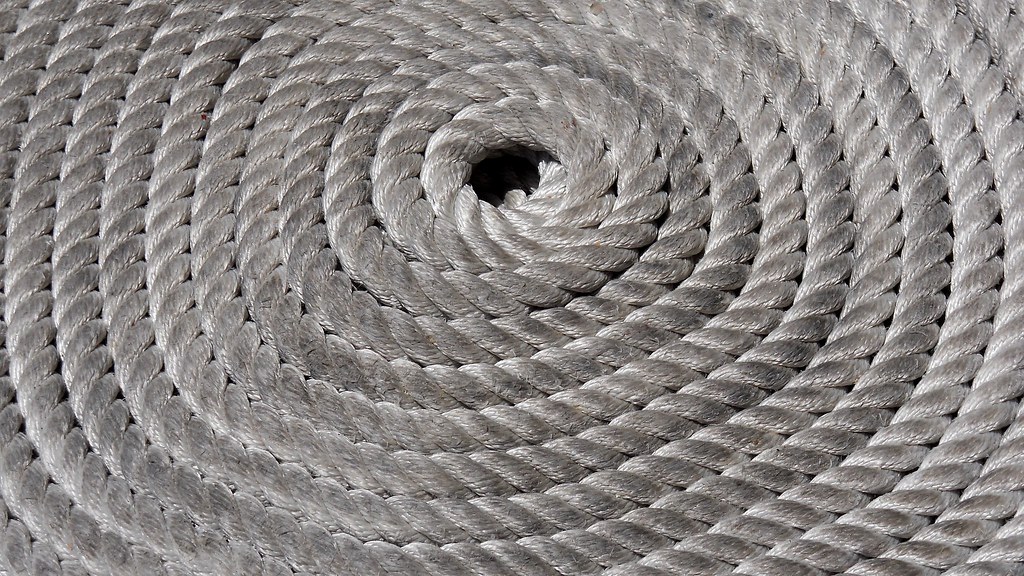
For docklines, Vik recommends three-strand nylon. It stretches roughly fifteen to twenty per cent at working load, which damps the surge of a wake or a wind shift and protects deck cleats and the boat's structure.
He does not recommend double-braid polyester for docklines, although it looks attractive on the shelf, because polyester stretches perhaps two per cent. The boat will not surge. It will instead jerk to a hard stop at the end of each motion and the cleats will, over years, work loose from the deck.
For halyards and sheets on a sailboat, polyester is correct, for the opposite reason. The sailor wants the sail to hold its shape, not to breathe under each puff.
For anchor rode, three-strand nylon again, for the same reason as docklines. The shock-absorbing stretch is essential. Vik has seen anchors dragged free in a midnight squall because the rode was too stiff.
Polypropylene is for floating throwing-lines and the occasional decorative purpose. It deteriorates quickly in sunlight and is slick under load. He does not recommend it for anything that holds a boat.
Dyneema, which is a high-modulus polyethylene marketed under several brand names, is the strongest rope per diameter on the wall. A six-millimetre Dyneema line has the breaking strength of twelve-millimetre polyester.
It is also, Vik says, often the wrong rope. It does not stretch. It does not knot well. It is expensive. He uses it for fixed standing-rigging substitutes on his own twenty-eight-foot wooden sloop, the Margit, but not for working lines.
Manila and sisal, the natural fibres, are kept by the shop for tradition and for restoration work on classic vessels. They rot when stowed wet, swell when soaked, and stiffen with age.
Solveig sells a few hundred metres a year, almost all to owners of pre-war yachts who care about visual authenticity.
Diameter matters less than people assume, beyond a working minimum. A dockline that is too thin will hold the boat but will be unpleasant to handle in cold weather with bare hands.
Vik recommends sixteen-millimetre for a thirty-foot boat, eighteen for forty feet, and twenty-two for anything larger. The breaking strength is far in excess of the load. The hand-feel justifies the diameter.
He keeps four lengths of sixteen-millimetre three-strand nylon on the Margit at all times. Two for the bow, two for the stern. Each is twelve metres, each spliced at one end into a permanent eye, each whipped at the bitter end.
They were bought from this shop in October 2016, and as of last week, when he checked them under harbour light at Bryggen, they had perhaps another two seasons before he would retire them.
He does not, he says, find any of this complicated. He finds the alternative, which is to buy whatever rope is on sale, complicated.