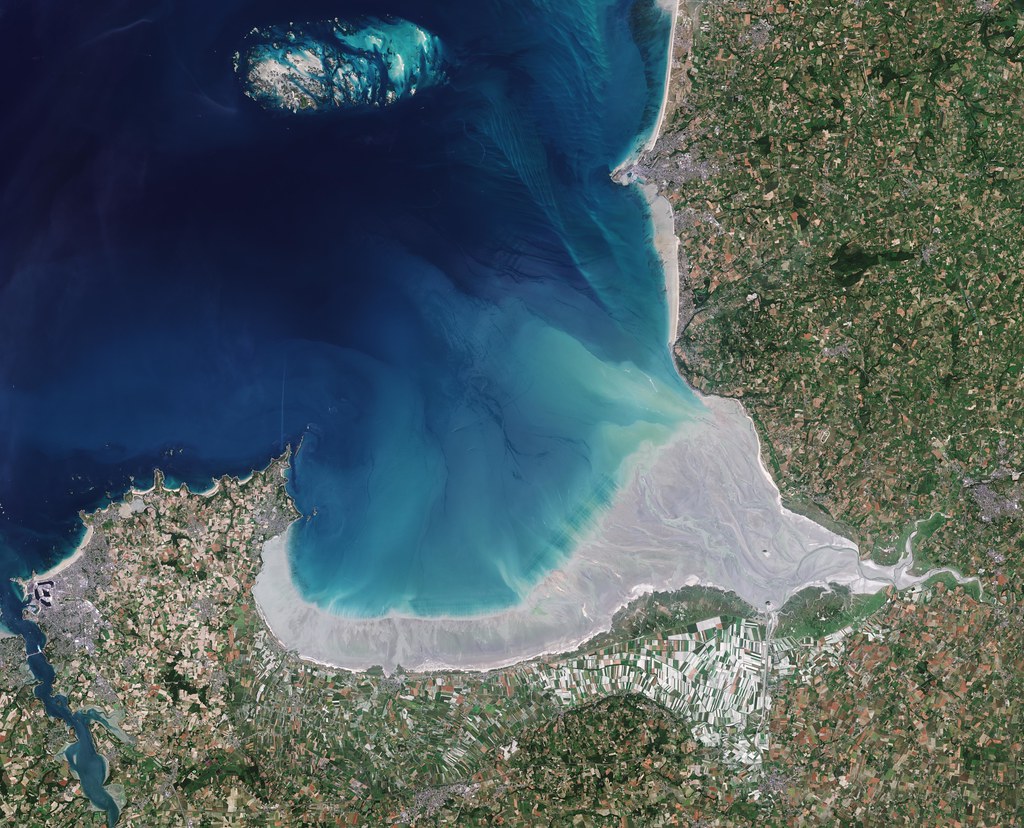
The tide arrived on the evening of 8 April 2026 at the predicted hour of 20:47, having travelled from the Atlantic across roughly 600 kilometres of continental shelf. It came in across the bay of Mont-Saint-Michel at a speed that French guidebooks have, for two centuries, compared to a galloping horse.
The comparison is inexact. The leading edge of the rising tide across the broad flats of the bay moves at about six to seven kilometres per hour at its fastest. A galloping horse runs at thirty. The flats, however, fill from many directions at once, and a person walking on them when the tide turns can be cut off by water rising behind them faster than they can return to shore.
Several people drown in the bay each decade. The official toll between 2000 and 2024 is twenty-one. Most were tourists who left the marked causeway on foot at low water and underestimated the bay.
The April 2026 tide was a grande marée, a great tide. The French Service Hydrographique et Océanographique de la Marine, known as the SHOM, predicts these tides several years in advance. They occur near the equinoxes and are larger when the moon is also at perigee, near its closest approach to Earth.
The April 2026 prediction was coefficient 113. The maximum possible coefficient is 120. Coefficient 70 is a typical spring tide. Coefficient 113 puts the high water at the Mont at roughly 14.3 metres above chart datum.
For comparison, the low water on the same day fell to 0.8 metres. The vertical tidal range at the Mont, on 8 April 2026, was 13.5 metres.
Per Lindgren, the retired Swedish naval hydrographer who edits Sea Marker's charts section, drove down from Caen on the afternoon of 8 April to watch the evening flood. He arrived at the parking area at 17:30, two and a half hours before high water. The shuttle bus to the abbey was already running at reduced frequency because of the expected crowd.
The crowd, by 19:00, was substantial. Estimates from the gendarmerie put the visitor count at around 12,000 for the evening, well below the summer peak of 30,000 per day but among the largest crowds the abbey sees outside high season.
At 20:15, the leading edge of the tide reached the base of the causeway. The causeway, rebuilt between 2009 and 2014 as part of a major project to restore the Mont's island character, is supported on pylons that allow the tide to flow freely beneath it. At high spring tides, the road surface itself is submerged for about two hours.
By 20:35, water was crossing the road. The tourist shuttles had been suspended at 19:30. The last walkers were guided back to the mainland by gendarmes in waders.
By 20:50, the Mont was an island. The water around its walls was three metres deep where, two hours earlier, gulls had been standing on wet sand.
The restoration project that returned the Mont to its tidal isolation was driven by a long-running silting problem. The old causeway, built in 1879, had blocked the natural tidal scour around the rock. Silt accumulated. By 2000, the Mont was effectively connected to the mainland by a permanent expanse of grassed-over sediment.
The new arrangement, completed at a public cost of roughly 200 million euros, is meant to allow the bay to scour itself. The Couesnon River, dammed near the abbey, is now used to flush sediment seaward during low tides. The flush is timed to the tidal cycle.
Per Lindgren, watching from the new pedestrian bridge, noted that the engineering was working. "You can see it in the current," he said. "The water is moving sideways, not just in and out. The bay is breathing again."
The breathing is not yet complete. Sediment that took 130 years to accumulate will take decades to remove. The project's engineers expect another twenty years of work before the Mont's surroundings approach their pre-1879 condition.
In the meantime, the Mont is on its way to being an island once more.
At 21:00 on 8 April, the abbey's silhouette was reflected in three metres of black water. The interior was still open to visitors, who had been advised to remain on the rock until the tide receded after midnight or accept a long wait on the dry side.
Most stayed. The abbey's small cafés did a brisk trade in coffee and crêpes. The 11th-century church, which has heard a thousand years of tides, was particularly quiet.
By 04:30 the next morning, the low water had returned. The shuttle buses resumed at 06:00. By eight, the parking lot was filling with day visitors who had come to see the Mont in its more familiar daytime form.
They did not, most of them, know what had happened at 20:47 the night before. The Mont does not advertise its tides. Anyone who wants to see one looks them up themselves.