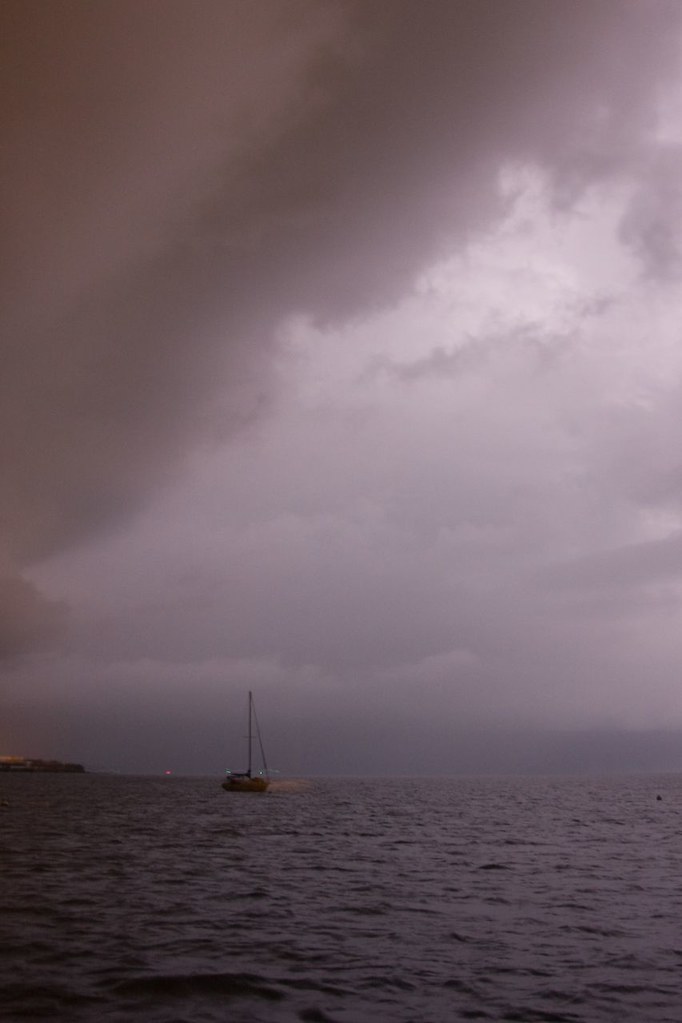
On the afternoon of July 21, 2023, a 32-foot sloop named Carolina Hush was sailing on a beam reach across the lower Chesapeake Bay, two miles east of Wolf Trap Light. The wind had been southwesterly at 11 knots since noon. The skipper, a retired Air Force colonel named Will Dorrance, had a guest aboard and a reefed main and full jib up.
At 1418 he noticed a dark band along the western horizon, well-defined, with a flat upper edge that suggested an outflow boundary. He estimated its distance at six nautical miles. He dropped the jib, started the auxiliary diesel, and turned the boat onto a course that pointed the bow at 220 degrees magnetic, into the approaching wind.
At 1426 the band reached him. The wind shifted in three seconds from 11 knots southwesterly to 41 knots from the northwest, with a peak gust later estimated by NWS reanalysis at 53 knots. Driving rain reduced visibility to under fifty yards. The boat heeled violently, then came upright as the reefed main spilled wind.
The squall passed in eleven minutes. Dorrance and his guest, both wearing harnesses, finished their afternoon on the bay in residual 15-knot winds and 3-foot chop. Carolina Hush returned to her slip at the Hampton Yacht Club at 1745. Dorrance has used the day as a teaching example for the basic seamanship class he runs at the club every spring.
Camille Vasquez, a sailmaker at Quantum Sails Hampton who finishes the class with her own session on heavy-weather sail handling, calls the line squall the single most dangerous weather phenomenon a Chesapeake weekend sailor will ever encounter. Most sailors who lose a boat to a squall, in her experience, lose it because they did not act in the eight to twelve minutes between visual identification and arrival.
A line squall is the leading edge of a thunderstorm complex, often well ahead of the parent storm, where cold downdraft air spreads out under the storm and meets the warmer ambient air. The interface is the outflow boundary or gust front. Wind speeds at the gust front commonly reach 40 to 60 knots in summer Chesapeake squalls.
The boundary is visible on the water before it is visible in the sky. Vasquez teaches her students to look for the scud roll, a low horizontal cloud feature that often precedes a gust front, and for the water line, a sharp transition on the surface where wind-driven spray begins. The water line is the most reliable visual indicator and the easiest to miss, because most sailors are looking at the sky rather than the surface.
Once a line squall is identified, the eight to twelve minutes that follow determine the outcome. Vasquez teaches a fixed sequence. Drop the headsail first. Reef the main second; deeply reef if possible. Start the auxiliary engine. Don personal flotation devices and harnesses. Brief crew on tasks. Stow loose gear. Turn the bow into the expected wind direction.
The expected wind direction is not the current direction. In a Chesapeake summer squall the wind almost always shifts to the northwest, regardless of the prevailing direction. Vasquez tells her students to assume the new wind will be from 290 to 330 degrees magnetic and to position the boat accordingly before the front arrives.
The reefing question divides her class every year. Some students argue for furling the main entirely. Vasquez disagrees. A bare-poled boat in 50 knots of wind from an unexpected quarter can be impossible to steer, and the loss of steering control is the precondition for most squall casualties she has investigated in twenty-six years on the bay.
A deeply reefed mainsail, by contrast, provides enough drive to maintain steerage and enough back-pressure on the rig to prevent the boat from rounding up uncontrollably when the gust hits. The reef should be the deepest reef the boat carries. On a sloop with three reef points, the third reef is correct. On a boat with only one, that one.
Some boats, including older fractional-rigged sloops, are difficult to balance under a deep main alone. Vasquez recommends a storm staysail set on an inner forestay for those boats, with the storm staysail hanked on and ready to hoist before the squall arrives. Hoisting any sail in 40-knot winds is too dangerous to attempt.
The engine is not for propulsion. The engine is for steerage in case the rudder loses bite when the boat is laid on her side. Vasquez has seen engines saved boats in squalls and has also seen propellers fouled by stray lines pulled overboard in the moments of the front. She tells her students to make sure no lines are trailing in the water before the squall arrives.
Personal flotation devices and harnesses are required. Vasquez's instruction is unambiguous: any crew member not below decks during a squall must wear an inflatable PFD and be clipped to a jackline running fore-and-aft on deck. The clipping point matters more than most sailors realize. Clipping to a single attachment point near the helm can pull a crew member overboard if the helm is unmanned.
The crew briefing takes thirty seconds. Vasquez's standard briefing: The wind is going to shift to the northwest and hit us hard. Hold on. Do not try to adjust sails. If anyone goes overboard, hit the MOB button on the GPS and throw a cushion. We will not turn back until the wind settles.
The last instruction is the hardest for new sailors to accept. Turning a boat in 50 knots of wind to recover a person overboard is more dangerous than completing the squall passage and recovering in the residual conditions. Most modern offshore racing rules now require crew overboard recoveries to wait for survivable conditions; the same rule applies, informally, in squalls.
Vasquez has investigated, formally or informally, eleven fatal squall incidents on the Chesapeake since she joined Quantum in 2004. Nine of the eleven involved boats under 30 feet. Eight involved skippers with fewer than fifty hours of single-handed sailing experience. All eleven occurred on Saturday or Sunday afternoons in June, July, or August.
The pattern is not random. Summer weekend afternoons are when the convective potential of the bay is maximal and when the inexperienced boater population is on the water. The squall does not select for inexperience; it simply finds it.
Vasquez ends her sessions with a small honesty. She tells her students that she has been caught by a squall four times in her own career, despite teaching the recognition and response sequence for twenty years. Twice she handled the squall correctly. Twice she did not. The two she did not handle correctly happened because she was tired or distracted or both.
She tells them that the goal of the class is not to make them immune. The goal is to make the response automatic enough that they do it correctly even when they are tired or distracted. The squall will eventually find them. The question is what they have already practiced when it does.
Filed under