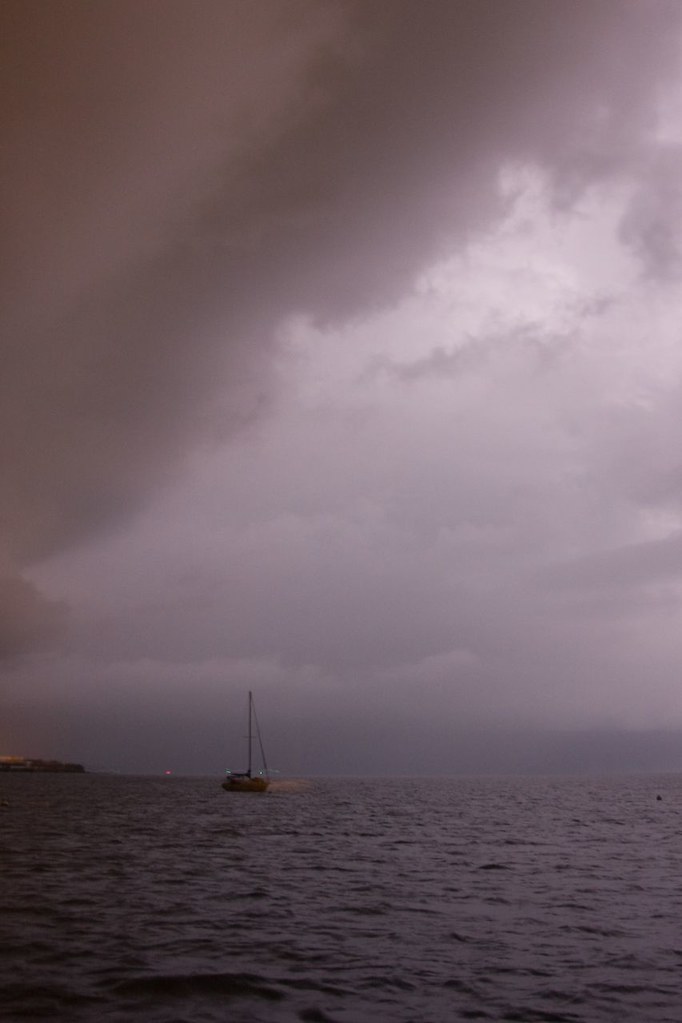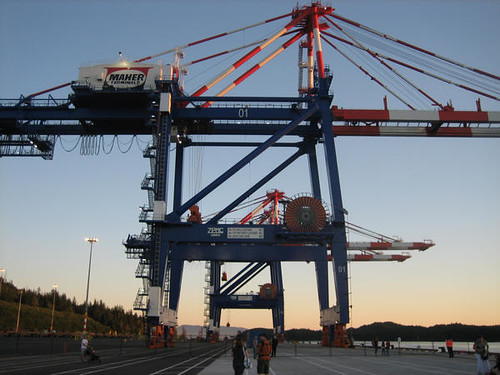
At 4:42 in the morning the gantry crane on Berth 6 at the Norfolk International Terminal lifts a forty-foot reefer off the deck of the Maersk Lavras and pivots it inland against a sky the colour of wet slate. The crane operator, a woman named Renata Eubanks who has worked the box for nineteen years, will move forty-one containers in her four-hour shift, which is below her average but not by much.
She does not see the boxes she lifts. From the cab eighty-seven feet above the apron she sees only the spreader beam, the painted target line, and a pair of work lights tracking with her on the shore crane's outriggers.
The Port of Virginia handled three point seven million TEU last year, a figure that has grown for eleven consecutive quarters. NIT, the largest of its four marine terminals, processes about sixty percent of that volume on roughly five hundred and sixty acres of paved ground east of Hampton Boulevard.
From the road the terminal reads as a static thing. From inside the fence it reads as choreography.
Ferdinand Beasley, the night superintendent, takes a visitor through the gate at 5:15. He has thirty-one years on the docks, the last eight in management. His radio chirps every forty seconds with a different voice asking a different question, and he answers most of them without slowing his walk.
He explains the stowage plan first. Every ship arriving at NIT has a load plan generated in Singapore or Rotterdam, depending on the line, and the terminal's planners spend the eight hours before berth working it into a discharge sequence that matches the yard's current stacks.
A box that has to come off in the first hour is one that has been booked for an urgent inland move. A box that can wait until the eighth hour will go to a deeper stack where the straddle carriers can get to it on Tuesday.
The straddle carriers move at fifteen miles an hour with a forty-five-ton load suspended between their legs. They are operated by a single driver in a cab that sits, oddly, off-center above the right rear wheel. The driver looks down at the box she is carrying through a small panel of reinforced glass set into the cab floor.
Sherrell Munroe has been driving straddles since 2017. She started after a back injury ended her work as a lasher on the ship side. She prefers the straddle, she says, because in the cab she is the only person who can hurt her.
The lashers are the most exposed workers on the apron. They climb the cell guides between the stacks to release the twist-locks that hold the containers to the deck. In summer the steel reaches a hundred and twenty degrees. In winter, particularly during a Chesapeake northeaster, the boxes ice over and the locks freeze.
Brendan Quill, a lasher with the Norfolk local of the International Longshoremen's Association, has been doing the work for six years. He is twenty-eight. He estimates that he will not be able to do it after forty.
The ILA contract that governs the East and Gulf Coast ports expired in late 2024 and was renegotiated in early 2025 after a brief strike that cost the industry roughly three billion dollars in delayed cargo. The most contested issue was not wages. It was automation.
NIT introduced its first semi-automated stacking cranes in 2022. The new equipment, in the rail-mounted gantries that move boxes between the apron and the inland yard, works without a human in the cab. A control room operator supervises four cranes at once from a screen on the second floor of the administration building.
The union accepted the change in exchange for guarantees on hours and a clause that protects the ship-side jobs, where the lashers and crane operators still work, from any further automation through 2030.
By 7:00 the day shift has arrived and the yard is at full intensity. Diesel from the straddles hangs over the apron in a faint blue layer. The cranes work to a count that is audible from the ground: the boom of the spreader landing on a stack, the metallic snap of the twist-lock, the long whine of the trolley moving inland.
A small office on the second floor of the terminal building contains the planners. Six women and four men sit in front of three monitors each, working what looks like a vast jigsaw puzzle of coloured rectangles. Each rectangle is a container. The colour denotes the line. The number denotes the inland destination.
Imelda Crouch, the senior planner on the morning shift, came to NIT from a similar job at Felixstowe in 2019. The work is fundamentally the same, she says, but the volumes at Norfolk are higher and the rail connections better. About a third of the boxes that come off the apron at NIT leave the terminal on the Norfolk Southern intermodal yard within twelve hours.
She watches a stack on her left screen turn from green to amber as a Hapag-Lloyd vessel late from Antwerp puts pressure on the discharge window. The vessel will dock at Berth 4 at 11:20 and is now expected at 13:50. The planners will adjust the sequence for two other ships in the harbour to absorb the delay.
Nothing visible happens. The plan rewrites itself on three screens and someone radios the inland yard to hold a set of moves.
At 12:30 the cafeteria fills with longshoremen on their first break. The room is loud and the conversation is mostly about the weather forecast, which is calling for sustained twenty-five-knot winds from the northeast by 18:00.
Wind closes the cranes. The threshold at NIT is forty-five knots gust, but operators slow their pace well before that. Renata Eubanks tells a visitor that she will keep moving boxes at thirty knots if the lift is light, but a heavy reefer in a crosswind is a different matter, and she will stop her own crane before the superintendent radios her.
By 16:45 the wind has reached twenty-eight knots and the Lavras has eleven containers left on deck. The crew on the apron pushes through, watched by Beasley from the dock office, and the last box swings down at 17:38. The lashers descend the cell guides and walk inland against the wind.
The terminal does not stop. The night shift arrives at 18:00 and another vessel, a Mediterranean Shipping Company box ship in from Algeciras, comes alongside at 19:15 to begin its discharge.
Beasley signs out at 19:40. He has been at the terminal for sixteen hours. He pulls out of the gate onto Hampton Boulevard in a Ford pickup with one hundred and ninety thousand miles on it, headed for a house in Chesapeake that he has owned since 1998. He will be back on the apron at 4:00 in the morning.