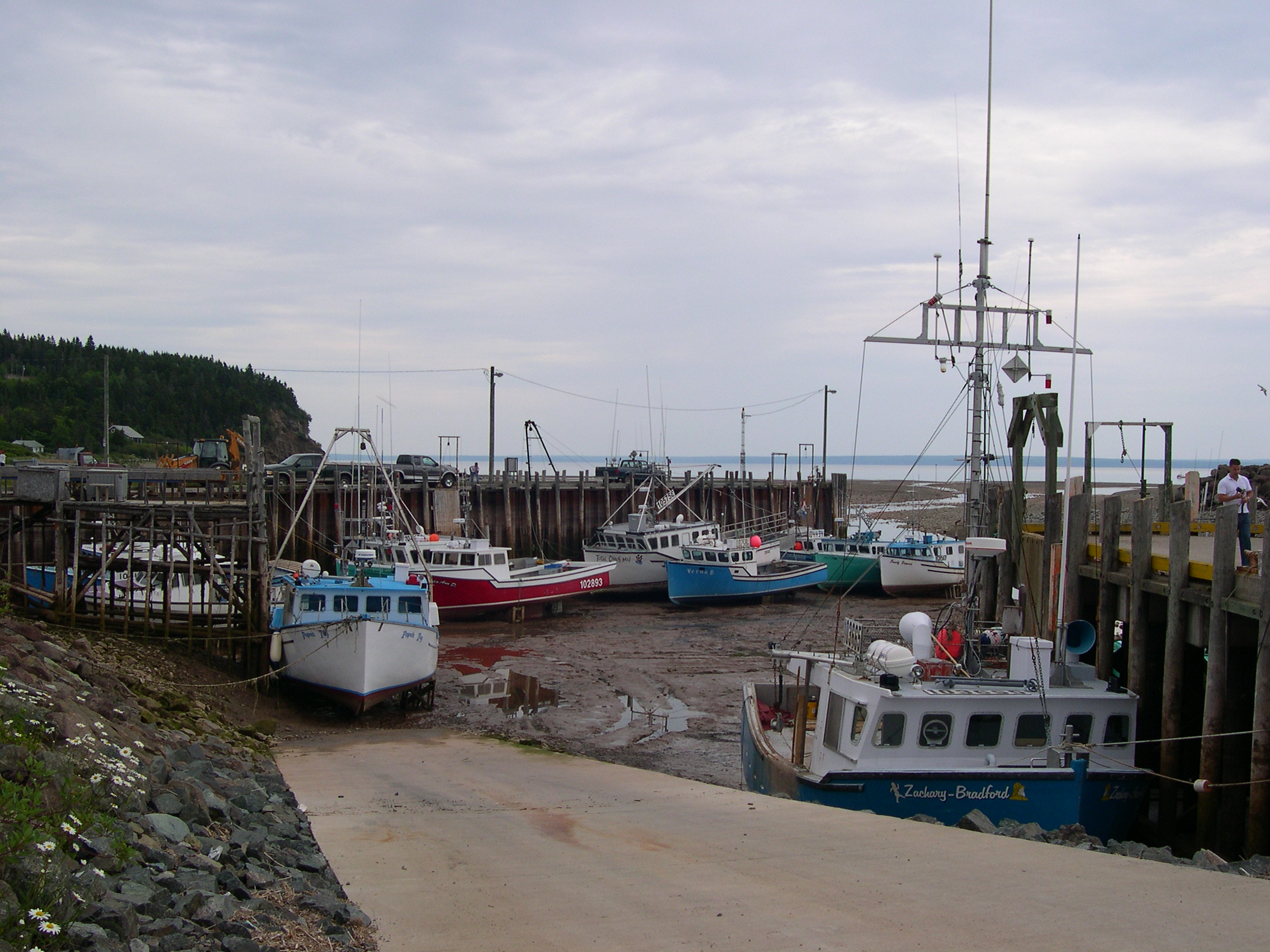
On the wheelhouse roof of the Tides Promised, a 42-foot Cape Islander out of Sandy Cove on Digby Neck, Nova Scotia, a small wired thermistor sits inside a Stevenson-screen miniature made from a four-inch length of white PVC drilled with eight ventilation holes. A second thermistor is mounted at deck level on the port quarter, sheltered from spray. Both feed into a battery-powered datalogger in the wheelhouse.
The setup belongs to Owen Surette, who took over the boat from his father in 2017 and has fished lobster on Lobster Fishing Area 34 since he was old enough to bait a trap. He installed the thermistors in March 2019 because he wanted to test a thing his father had told him about Fundy fog: that the fog rolls in from the height of the masthead downward, not from the surface upward, and that a skipper can sometimes see fog coming by feeling the temperature on his face change before the fog itself arrives.
Six years of logged data later, Surette has confirmed his father's claim with a precision the older man would have found unnecessary. On 73 percent of advection fog events recorded by the boat between March 2019 and December 2025, the masthead thermistor showed a temperature drop of at least 0.4 degrees Celsius before the deck thermistor began to drop. The lead time averaged eleven minutes, with a maximum observed lead of forty-three minutes.
The temperature gradient between masthead and deck, on a calm clear day in summer, is normally small and slightly inverted: the deck is warmer because it is closer to the sun-warmed water. When advection fog approaches, cold marine air spreads in at altitude first, often capping a shallow warmer layer near the water. The masthead thermistor crosses the fog boundary minutes before the deck does.
Surette built his datalogger on an open-source platform sold by a small Halifax electronics retailer for under two hundred dollars. He chose the two thermistor positions to give the longest practical vertical separation on his boat, about 4.2 metres. A longer separation would yield clearer signals; he is constrained by the boat's geometry.
Marine scientists at the Bedford Institute of Oceanography in Dartmouth have shown interest in his data set. Dr. Rosalind Tupper, who studies marine boundary layer meteorology at the institute, told Surette in correspondence that his observations were consistent with the limited tower-based observations available from the Bay of Fundy but provided much denser temporal sampling than any institutional source.
Tupper has asked whether Surette would consider expanding to a small array of similar boats. He has been reluctant. The installation requires a level of obsessive attention, he says, that he cannot expect of other lobstermen who already have enough to do.
What he has done is publish a simple text on the Lobster Fishing Area 34 association's private message board describing the principle, with diagrams. About sixty boats now carry some version of a vertical thermistor pair. The data is not centralized; each skipper reads his own log. But the principle has spread.
The lapse rate in the marine boundary layer is the gradient of temperature with altitude. In the standard atmosphere, temperature decreases with altitude at about 6.5 degrees Celsius per kilometre. Over warm water under stable conditions, the gradient can invert, with cooler air below warmer air. Over cold water beneath warmer air, the gradient can be steep, exceeding the dry adiabatic rate of 9.8 degrees per kilometre near the surface.
These distinctions are not academic for a small-boat operator. The lapse rate at the surface determines whether convection will develop, whether fog will form, whether the air will mix vertically or stratify. The lobstermen of Digby Neck have always known these things by feel. Surette has begun to quantify what they knew.
The Bay of Fundy is one of the foggiest stretches of water in North America, by some metrics second only to the Grand Banks. The fog is generated by the same advection mechanism as at Pemaquid Point a hundred miles to the southwest, with the additional complication of the extreme tidal range. The Fundy tides, exceeding fifteen metres at the head of the bay, drive water column mixing that keeps surface temperatures cold even in August.
When the cold surface water meets the warm summer air drifting east from New England, fog forms. The bay can be socked in for days. Surette's boat, equipped with radar, AIS, and a Furuno chart plotter, can work safely in the fog, but the fishing itself becomes harder when traps must be located by GPS coordinates rather than by line of sight to landmarks.
His logger data shows that fog days in his fishing area have increased slightly over the six-year record, from an average of 71 days per year in 2019 to 79 in 2025. The trend is too short to be statistically meaningful, and Surette is cautious about reading climate signal into it. He notes only that the trend goes the opposite direction from what climatologists have hypothesized for the Gulf of Maine.
The Gulf of Maine and the Bay of Fundy are not the same water body. The Bay's circulation is dominated by tidal mixing rather than by the warming surface trends that drive the Gulf's record. Surette suspects, but cannot prove, that the Bay's fog regime may be more stable than the Gulf's against climate change because the cold surface temperatures are tidally enforced rather than thermally enforced.
Tupper has told him the hypothesis is plausible and worth testing on longer time scales. She estimates that 25 to 30 years of continuous observation would be needed to separate climate signal from year-to-year variability. Surette is 38. The 25-year horizon is not impossibly remote.
He has accepted, in the meantime, that his logger is a tool of his trade as much as his hauler or his trap traps. He uses the lead-time signal from the masthead thermistor on most foggy days to begin slowing the boat and switching the radar to short-range mode before the fog actually arrives. The lead time, even when only eleven minutes, is operationally useful.
On June 4, 2025, the logger picked up a 1.2 degree Celsius drop at the masthead at 0517. The deck stayed warm. Surette switched the radar to a quarter-mile range and reduced the boat's speed from twelve to seven knots. Fog enveloped the boat at 0533, sixteen minutes after the masthead alarm. The deck thermistor crossed into the fog at 0531.
He hauled twelve traps in the fog over the next two hours. The hauls were ordinary. He returned to Sandy Cove at 1140 with 240 pounds of legal lobster and a clean log entry for the day.
His father, now 71 and ashore for most of the year, looked at the day's printout that evening at the kitchen table in the small house above the harbour. He asked Owen if the readings were what he had expected. Owen said they were.
His father said he had been telling people about the masthead fog for fifty years. He said it was nice to see the numbers. He went back to his coffee. The next morning the boat was out again at 0445, and the thermistors were running, and the bay was clear.
Filed under