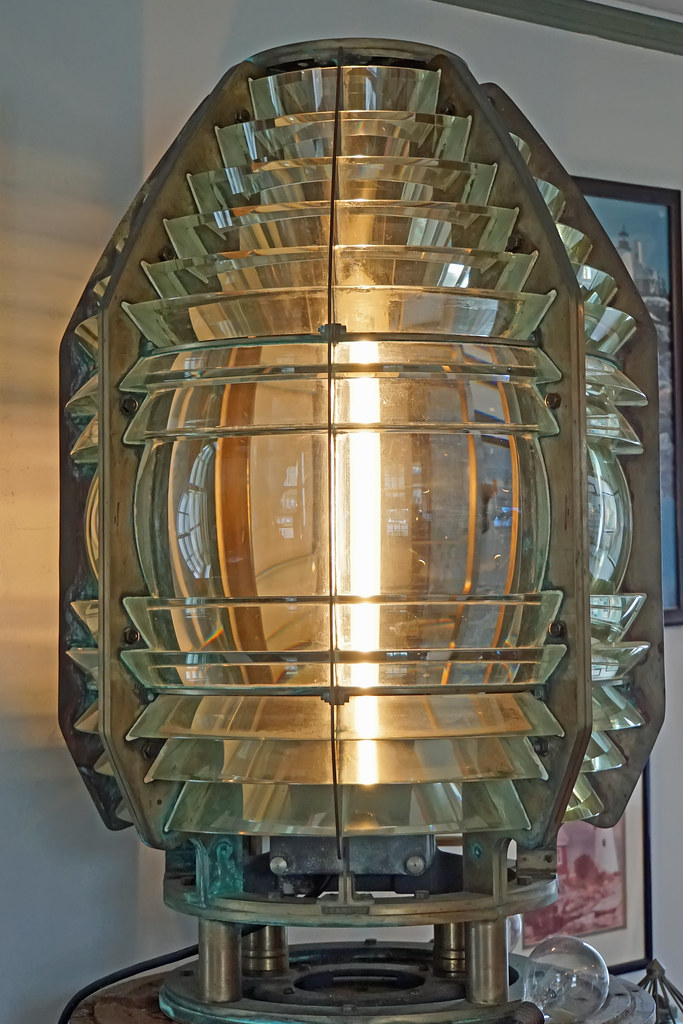
Helena Bridger keeps her observation notebook on the second shelf of a built-in bookcase in the front room of her cottage on Lighthouse Road, Bristol, Maine. The cottage is the fourth-closest dwelling to the Pemaquid Point Light Station, and from her kitchen window she can see the lantern room of the 1827 tower, the same view her grandmother had from the same window in the 1950s.
She has kept the notebook since January 1, 2025. Every morning at 0600 and every evening at 1800, with intermediate entries whenever conditions change sharply, she writes one line: time, visibility estimate in nautical miles or yards, wind direction by compass quarter, sea state by a private four-grade scale she has used since her years on a research vessel out of Bigelow Laboratory in the 1990s.
The line for January 12, 2025, reads: 0600 / 200 yd / SE light / smooth / advection fog dense, dripping. The line for July 4, 2025, reads: 0600 / 8 nm / W light / 1 ft chop / haze only. She has 730 such lines for the year. Two hundred and eighteen of them, by her count, record fog of some kind.
Pemaquid Point projects about a mile and a half into the open North Atlantic at the eastern boundary of the Gulf of Maine. The land mass narrows to a finger of metamorphic schist that has been worn into the long parallel ribs the tourists photograph. Water temperatures in the surface mixed layer offshore stay below 50 degrees Fahrenheit through most of the summer, while air over the warmer land mass to the west can pass 70 degrees by noon.
The temperature differential is the engine of advection fog at the Point. Warm moist air moves over cold water, the air cools to its dew point, and visibility collapses. The official observation station at the National Weather Service site eight miles inland in Newcastle does not register this fog because the fog is a coastal artifact and dissipates within a mile of the shoreline.
Bridger's notebook captures what the official record cannot. Her 218 fog hours for 2025 are concentrated, as expected, in May, June, and July, with a secondary peak in October. The June total alone was 67 hours, more than two full days of dense fog spread across the month in events typically lasting from before dawn until mid-morning.
What surprised her, looking back at the year, was the distribution within those months. Foggy mornings did not cluster around the new moon or the full moon. They did not correlate with tide stage in any way she could find. They correlated with wind direction: 84 percent of her fog events arrived on winds from the south through east-southeast.
She wrote a short note to herself in the back of the notebook on July 28, 2025: Pattern confirmed. The wind direction predicts fog better than any other variable I track.
Donal Crehan, who teaches coastal meteorology at the Maine Maritime Academy in Castine and has reviewed Bridger's data set, says the pattern is consistent with the regional climatology but more sharply expressed than the textbook would predict. Crehan suspects the local geometry of Muscongus Bay funnels warm continental air over the cold water in a way that concentrates fog formation at the Point itself.
Bridger has provided her notebook to the Maine Lighthouse Museum in Rockland for the 2026 season's interpretive display. The museum's curator, Catriona Drake, asked her to write a short interpretive panel to accompany the photocopies. The panel reads, in part: The fog at Pemaquid is not weather. It is the meeting of one body of air with one body of water, repeated every summer day that the wind blows from the south.
The 1827 tower is no longer staffed. The light has been automated since 1934, and the fog signal, a horn audible at 6 nautical miles when active, runs on a fog detector mounted on the south side of the keeper's quarters. The detector is a beam-and-receiver unit installed in 2008. It triggers the horn when visibility drops below approximately two miles.
Bridger's notebook records two episodes during 2025 when the horn did not sound during conditions she had measured as well under two miles. One occurred on the morning of April 7, when fog moved in from the southeast at 0445 and the horn did not start until 0612. The other was on October 13. She reported both to the Coast Guard Aids to Navigation team in Southwest Harbor.
The Coast Guard investigated both reports and replaced a relay in the detector circuit in late October. Lieutenant Marcus Tan, who oversees the aids to navigation in the First District, told her in a follow-up letter that the relay had been failing intermittently for an estimated six months before her reports allowed them to localize the fault.
The letter, dated November 9, 2025, is now taped inside the cover of her 2025 notebook. She framed the small irony for herself: her amateur observations had improved the reliability of the federal fog signal.
Fog at Pemaquid has a sound profile of its own, separate from the horn. Bridger has come to know it. The Atlantic ground swell sounds different through fog than through clear air; the higher frequencies of breaking water on the basalt ribs are absorbed by the water droplets, and the bass of the swell against the cliffs predominates. She can tell, with her eyes closed in the front room, whether it is foggy outside without looking.
She has also learned to distinguish two kinds of fog by sound. Advection fog, the dense southerly fog that rolls in across the water, deadens sound from the road but not from the sea. Radiation fog, the rarer ground-formed fog that develops on calm clear nights over the local land, deadens road and sea equally and tends to lift faster after dawn.
Her notebook for 2026 began on January 1 in the same format. She has not made any methodological changes. The early data for January through March showed 19 fog hours, slightly below her 2025 figure for the same period. She is curious whether the year will track 2025 or diverge.
Climatologists at the University of Maine's Climate Change Institute in Orono have been in touch with her about contributing the notebook to a long-term coastal fog database they are assembling. The database, called CoastFog-NE, is intended to track changes in marine fog frequency along the New England coast as Gulf of Maine sea surface temperatures continue to rise.
The Gulf of Maine has warmed faster than 99 percent of the world's oceans in recent decades, and the climatologists hypothesize that as the surface water warms, the temperature differential that drives summer fog will narrow, and coastal fog frequency will decline. If their hypothesis is correct, Bridger's notebooks will become a baseline.
She has not committed to the database yet. She told the lead researcher, Dr. Adelheid Quint, that she would think about it through the summer. Her hesitation was not about the science. It was about whether the notebook, once digitized, would still be what it was when it lived on the second shelf of the bookcase.
Quint understood. She told Bridger that the database would be perfectly happy to wait, and that the notebook on the shelf was, for now, the most complete record of fog at one of the most reliably foggy points on the New England coast. The notebook can outlast Bridger, if she chooses, on the shelf or in the database or both.
The fog signal, when it sounds, lasts two seconds and is followed by an 18-second interval. The pattern repeats until the visibility detector decides the air is clear again. Bridger uses the horn cycle to time her morning entries when she cannot see the lantern room. Two seconds on, eighteen off; she writes one line, looks up, and closes the notebook.
Filed under