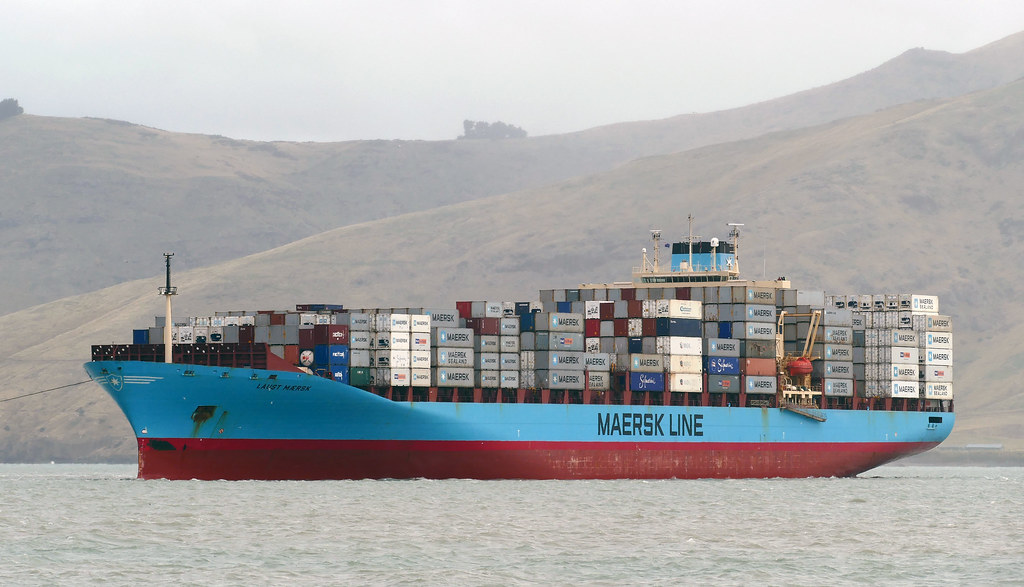
The Maersk Sembawang sailed from Algeciras at 03:40 on the morning of April 8 with eight thousand four hundred and twelve TEU in her stacks and a master who had been at sea for thirty-seven years.
His name was Knut Halvorsen and he had begun his career on a Stavanger-flagged bulker that no longer existed. He had been on container ships since 2001. He took the Sembawang in 2023 and would, he thought, retire in 2027.
The ship was eleven years old, three hundred and ninety-eight metres long, and registered in Hong Kong. Her crew of twenty-three was made up of nine Filipinos, six Danes, four Indians, two Croatians, a Romanian, and the master.
The bridge was on the eleventh deck of an accommodation block that sat aft, behind a stack of containers piled twelve high. The view forward was a wall of corrugated steel painted in the colours of nine shipping lines.
The first morning out of the Strait was clear and the wind was on the starboard quarter at fifteen knots. The Sembawang made twenty-one knots over the ground, which was a knot under her economic speed but the line wanted her in Newark on the morning of April 20 and the routing officer had pushed her up.
The chief mate, a Dane named Mads Brink, ran the daily routine. He had been on the ship for four months and would be home in Esbjerg in another two. He kept a small framed photograph of his daughter on the chart table in the cargo office.
Meals were served in two messes, one for officers and one for ratings. The food was the same in both: a Filipino cook named Ramon Casiño had been on the ship for eleven years and had earned the right to serve adobo on Tuesdays and Thursdays whether the second engineer asked for it or not.
The day on a modern box ship is organised around the bridge watch. The four-on, eight-off rotation gives each deck officer two watches in twenty-four hours, separated by an eight-hour rest that is meant to include a single block of at least six hours of sleep.
In practice the chief mate is often called in port and rarely sleeps six hours at a time. The second mate, a Croatian named Petra Kovač, kept the most regular hours and was the one most often seen reading on the bridge wing in the afternoon.
The cargo on the Sembawang was not glamorous. The manifest, which Brink showed a visitor on the third day, was largely European industrial goods bound for the American Midwest: machine parts from Lombardy, polymers from the Rhine, ceramic tiles from Castellón, frozen seafood from the Bay of Biscay.
There were also four reefers of Spanish hams, six of Belgian chocolate, and one of pharmaceuticals that required a separate alarm in the cargo office in case the temperature drifted out of the two-to-eight-degree range during the crossing.
The temperature did not drift. The ship's reefer monitor, a panel of about three hundred green lights with the occasional amber one, sat in a corner of the cargo office and was checked every two hours by the duty engineer.
On the fourth day the Sembawang ran into the edge of a low pressure system that the routing service had warned about. The wind came around to the west at thirty-five knots and the seas built to about four metres. The ship rolled six or seven degrees and the bridge crew slowed her to seventeen knots until the weather passed.
The crossing of the North Atlantic on a container ship is not the crossing of the North Atlantic on a sailing yacht. The Sembawang moved through the swell with the indifference of a building, and the only obvious sign of the weather was the lashings on the deck containers, which sang faintly in the wind.
The lashings were the responsibility of the bosun, a Filipino named Reynaldo Macasaet who had been at sea since 1992. He walked the deck twice a day in any weather under forty-five knots and tightened the turnbuckles by hand using a long steel bar called a tommy.
He had lost two fingers on his left hand in 2014 to a lashing that parted under load. He did not blame the lashing, he said. He blamed the chief mate of that ship, who had ordered the crew onto the deck in conditions that did not warrant it.
The work of running a container ship across the Atlantic is, in the absence of weather, mostly the work of waiting. The bridge watch is a long quiet vigil over a horizon that does not change, broken by the occasional radar contact and the regular hourly log entry.
The Sembawang did not see another vessel for forty-one hours during the middle of the crossing. The AIS showed traffic, but the ships were over the horizon and the bridge wings were empty of anything but the wind.
The crew did not look at the ocean much. They had seen it before. They watched movies in their cabins, exercised in a small gym on the seventh deck, played cards in the recreation room, and called home over the ship's satellite link, which the company had upgraded in 2023 to allow video calls.
Halvorsen, the master, walked the deck once a day with the chief mate. He talked about retirement and about a sailboat he was building, a thirty-two-foot wooden cutter that he had begun in his garden in 2019.
He did not know whether he would finish it. The wood, he said, was teaching him patience that thirty-seven years at sea had not.
The Sembawang made her landfall at Ambrose Light at 09:14 on April 20 and a Sandy Hook pilot came aboard at 09:50. The ship was alongside in Port Newark at 13:30, twelve days and one hour after she had sailed from Algeciras.
Brink supervised the discharge from the cargo office. Halvorsen went to his cabin to call his wife. The crew worked through the night and would sail again at 06:00 on April 22, bound for Charleston and then back across the Atlantic to Bremerhaven.